The Sketchbook Myth: Every Page Need Not Be Finished
Sketchbook rough pages keep questions, alternatives and visual discoveries visible, helping you choose what to develop without polishing every trial.
A sketchbook does not need to look finished to be useful. Rough sketchbook pages can preserve a question, an alternative or a small visual discovery that polished work might hide. The useful choice is not “neat or careless”; it is deciding what each page needs to do.
Think of the book as a workbench, not a gallery wall. A workbench can hold an unfinished joint and a few spare parts without pretending to be a display cabinet. Some pages will be resolved drawings. Others should stay open enough to invite another mark.
What does this page need from you?
Before smoothing a line or filling a blank corner, name the page’s job. It may be helping you notice, compare, remember or communicate. Those jobs do not call for the same degree of finish.
- Noticing: Record a shape, gesture or arrangement before it slips from attention.
- Comparing: Put several versions beside one another so their differences are easy to see.
- Remembering: Keep a detail that may help with a later drawing, such as the broken edge of a leaf or the angle of a folded sleeve.
- Communicating: Make a page legible to another person, or clear enough to guide a specific piece of work.
If the page is for noticing, a few searching marks may be enough. If it is for communicating, labels or a clearer silhouette may help. Finish is a tool for a purpose, not a verdict on the drawing.
Which situation are you in?
Are you trying to understand an unfamiliar form?
Keep the marks provisional. Draw the same object from a few angles, or test its broad shapes before committing to detail. The page is useful if it shows what you still do not understand, not if it disguises uncertainty under careful shading.
Do you have several competing ideas?
Give each version room and keep them visible together. Avoid developing the first one so fully that the others seem weak by comparison. A small note such as “wider”, “lower” or “less crowded” can make the next decision clearer.
Are you collecting a detail for later?
Draw the feature that matters and add a brief label if memory may alter it. A quick study of the seam on a coat need not include the whole figure. Keep enough context to recognise what the detail belongs to.
Does someone else need to read the page?
Make the relevant shapes and notes clear, but do not polish unrelated areas. A collaborator may need a readable pose, a placement cue or a colour note. Clarity is useful here; decorative completion is optional.
When should a rough trial become a finished drawing?
Develop a page when it has begun answering the question that matters, and when more finish would help you use that answer. If you are comparing three silhouettes, settle on one before adding refined texture. If a loose study has revealed a more convincing gesture, redraw it on a fresh page rather than forcing the exploratory page to carry every later decision.
Keep a rough page rough when it contains useful alternatives or when detail would narrow the inquiry too soon. This is not an argument for leaving every drawing untouched. It is a way to stop finish from becoming an automatic fee charged to every idea.
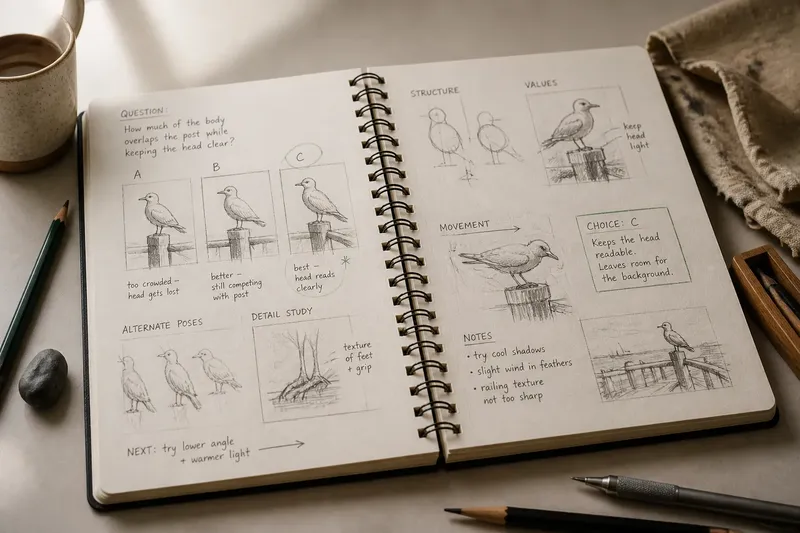
Imagine you are planning an illustration of a bird on a railing and cannot decide how much of the body should overlap the post. You make several small arrangements in pencil, then mark the one where the head remains easy to read. The expected result is a visible comparison you can return to, rather than a polished first arrangement that has crowded out the others. The page can stop there until you need to develop the chosen pose.
How can you keep rough pages useful later?
A page does not need to be tidy, but it should leave you a way back in. Use small, practical cues rather than turning every spread into a presentation:
- Write the question beside the marks, such as “Which overlap keeps the hand clear?”
- Label alternatives with letters or short descriptions.
- Circle a promising fragment without erasing the versions around it.
- Add an arrow to show a direction of movement or a change you intend to test.
- Note the material or colour you want to try next, if that choice matters.
- Leave a blank margin for a later thought instead of filling every open patch.
These cues turn a rough spread into a record of decisions, not a collection of unexplained marks. They also make it easier to return after time away without trying to reconstruct your reasoning from a mysterious smudge.
What if the roughness feels like failure?
Separate a drawing’s appearance from its usefulness. A tangled page may still show that one pose was too stiff, that a shape needs more room or that a particular tool makes the mark you want. If none of that is visible, add a short note about what you learned or what remains uncertain. You are not obliged to rescue the page by making it attractive.
At the same time, roughness is not automatically productive. Repeating marks without looking at their differences can fill pages while leaving the question untouched. Pause when a trial stops changing what you notice. Then choose: make another deliberate variation, keep the useful part, or move on.
The sketchbook myth treats every page as a small performance. A more useful standard is whether a page lets you see, compare or remember something you could not see as clearly before. That is enough reason to keep a rough sketchbook page, and a good reason to leave it unfinished.