A Pocket Study of One Window on a Rainy Afternoon
A rainy window drawing can separate reflections, outdoor shapes and softened edges, helping you record the view clearly with a pencil and a small page.
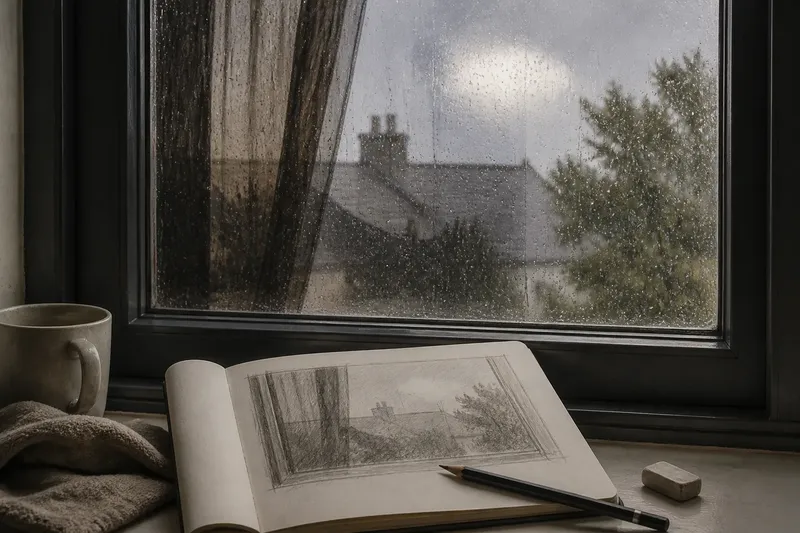
How do you draw a rainy window without turning the page into a map of every raindrop? In a rainy window drawing, begin with the frame, one reflection and one patch of light; let the glass remain mostly blank.
Choose a seat where you can see the pane without leaning or twisting. A pocket sketchbook and an HB pencil are enough. Keep an eraser nearby, but use it to clarify a shape rather than to tidy away every uncertain mark.
What should you include in a rainy window drawing?
Start with the visible boundaries of one pane and the frame around it. Add the divisions between panes if they help locate a reflection. A sill, curtain or plant belongs only if it changes how the glass reads.
Rainy glass often holds two images at once: forms beyond the window and reflections from the room. You do not need to identify every source. Record a pale patch, dark band or blurred rectangle where it appears in relation to the frame.
Use the pane divisions as landmarks. If a dark shape reaches a crossbar and then disappears, place it there rather than drawing it as a complete object. This keeps the study anchored to what is visible, even when the view itself is ambiguous.
How can you separate reflections from the view outside?
Look for overlapping shapes rather than trying to solve the scene into a tidy diagram. A reflection may cross an outdoor silhouette without following its edge. A curtain can appear as a vertical band over a roof, tree or patch of sky.
Block in the larger shapes lightly before adding smaller marks. Shade a reflection with the side of the pencil, leaving the brighter areas of paper untouched. Add a few droplets or streaks only where they interrupt a shape or soften its edge; a catalogue of water beads is rarely the point.
Think of the pane as a clear folder holding two sheets of paper: their shapes overlap, but they do not become one picture. In the drawing, a broken edge or a change in tone can show that overlap without labelling its source.
Which edges should stay sharp or soft?
A dark frame against a pale pane may have a crisp boundary. A distant tree softened by wet glass may not. Give these edges different treatment instead of outlining each object with the same firm line.
Use firmer pencil pressure for a clear frame edge, then ease off or break the line where a shape fades into its neighbour. With a pen, leave small gaps rather than imitating a blurred pencil mark. The aim is to distinguish the edge you can see from the one your knowledge of windows supplies.
Say you see a black window bar, a pale roof beyond it and a curtain reflection cutting across both. If the roof disappears under the reflection, draw the bar clearly, leave the roof line incomplete at the crossing, and add the curtain as a lighter band. The expected result is three readable layers without inventing a continuous outline for the hidden part.
What changes when the light shifts?
Choose one patch of light on the pane, sill or view outside. Mark its position and broad shape, then look again after a pause. If its edge has softened or moved, add a second faint indication beside the first and note “softer now” or “shifted”. Keep the two observations distinct rather than combining them into a single impossible moment.
If the light seems steady, notice what it reveals or hides. A bright reflection may obscure a shape behind it; a darker pane may make a pale outdoor form easier to see. Leave the brightest paper unmarked and shade around it, much as the shape of a cut-out depends on the material surrounding it.
What do readers ask about rainy window drawing?
Do I need to draw every raindrop?
No. Mark only droplets or streaks that interrupt a reflection, soften an edge or alter a patch of light. Leave the rest of the pane open.
What if I cannot tell what is reflected?
Draw the shape and its position in relation to the pane divisions without naming its source. If it crosses a lighter form, record the overlap and leave the identity unresolved.
How can I show a soft edge with graphite?
Use light pressure, a faint shading mark or a small gap between neighbouring tones. Avoid drawing a blurred outline around every shape; one or two softened boundaries can make the contrast clear.
What if the light changes before I finish?
Keep the first marks as a record of the earlier view, then add a separate faint note for what changed. If the scene has altered too much to compare, start a second small study beside the first.
How can you keep the page focused?
Limit the drawing to one pane or a small rectangle in the sketchbook. Let the frame, overlapping shapes and light patch carry the scene. Leave out room details that do not explain what is happening on the glass.
- Check whether the frame is visible; if it is, place its main boundary, then omit hidden sections rather than guessing their path.
- Check whether a reflection crosses an outdoor shape; if it does, break the outdoor edge at the crossing, then avoid drawing a continuous line through the reflection.
- Check whether a dark band belongs to a clear frame edge or a softer reflection; if the edge is crisp, use a firm mark, but if it fades, use lighter pressure or a broken line.
- Check where the brightest patch sits; if it is still visible on the paper, leave it untouched, but if it has been shaded over, lift only the portion that needs to read as light.
- Check whether droplets change the larger shapes; if they interrupt an edge or reflection, mark a few, but if they do neither, leave them out.
- Check whether the view has shifted since the first marks; if it has, add a separate note or start a second study, but if it has not, keep the existing drawing and stop adding detail.
Imagine the following invented situation: from a chair, you see one pane with a dark curtain reflection, a pale sky patch and a roofline partly hidden by the reflection. First, you mark the pane divisions in light graphite. Next, you add the roofline only up to the dark band, shade the band lightly, and leave the sky paper white. Then you look again and find the band’s edge less distinct; you break that edge with a few light marks instead of redrawing the roof through it. The resulting study shows where the reflection, roof and sky meet, while leaving the hidden part of the roof unresolved.
For a rainy window drawing, finish by checking the broad relationships: where the largest reflection sits, whether the frame still reads clearly, and whether the light patch remains light. Add a mark only if it makes one of those observations easier to see. A small study can stop while the weather is still offering more details than the page needs.